
The empowered photographer
Christopher Anderson's White House photographs for Vanity Fair

Vanity Fair’s publication of Christopher Anderson’s photographs of major personalities in the Trump White House has provoked considerable controversy. Much has centered around his unretouched, at times revelatory depictions of those who have rarely been viewed unmasked or on terms other than their own. His detractors insist that Anderson has not been playing by the unwritten rules of “celebrity” portraiture.
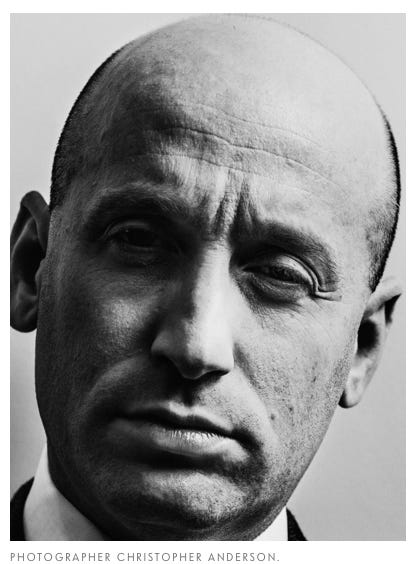
Coming out at the end of a year rife with chaos in visual media, with the emergence of masses of AI-generated imagery and untold numbers of other images of uncertain credibility, Anderson’s photographs, such as the ones of White House Chief of Staff Susie Wiles and Deputy Chief of Staff Stephen Miller (both below), seemed to reaffirm photography as a means of speaking truth to power. Unvarnished, they were seeking an understanding not only of the people portrayed, but of the government they represent that has upended so much of society as we previously knew it.
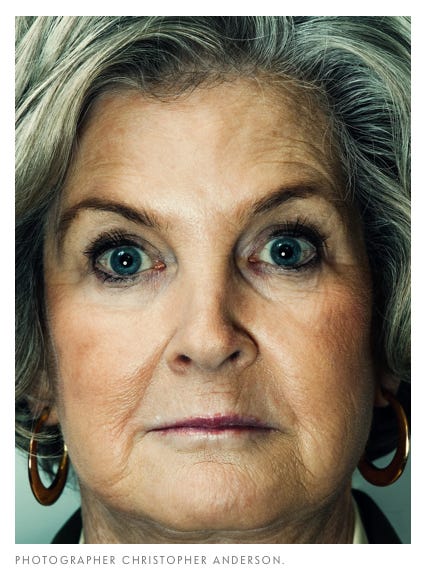
In an email shared with Newsweek, the photographer wrote: “I think the internet is a weird and sometimes entertaining place. Obviously, I assumed photos of the political world would generate some attention. It is curious that the internet is shocked that I would not retouch the blemishes. I guess I find it shocking that people would expect that journalistic photos should be retouched. Celebrity photos are celebrity photos. Politicians are not celebrities. Let’s not mix things up.”
Or, as he summed up his approach: “Above all else, [I] try to cut through the image that politics want to project and get at something that is more truthful.”
A similar controversy as to how politicians should be photographed previously erupted in 2008. As Sandra Winn reported then on trendhunter.com: “This week’s Newsweek cover photo shows governor and GOP Vice Presidential nominee, Sarah Palin in a way that many are not accustomed to—she isn’t all glammed-up. The Newsweek cover is, according to conservatives, an unflattering close-up. Palin’s picture has obviously not been touched up or airbrushed, and a few wrinkles, bags and crows-feet under her eyes, a pimple, as well as lip hair can be seen. The headline beside the picture is non-flattering as well and reads, ‘She’s one of the folks (that’s the problem).’
“The controversy, according to Andrea Tantaros, a Republican media consultant, is that Newsweek photos of Obama have been retouched to make him look good. Tantaros also said that the cover of Sarah Palin is a ‘slap in the face after so many Newsweek covers have been favorable to Obama.’ In her interview with Fox News, Tantoros calls for ‘regular folk’ to cancel their Newsweek subscriptions.”
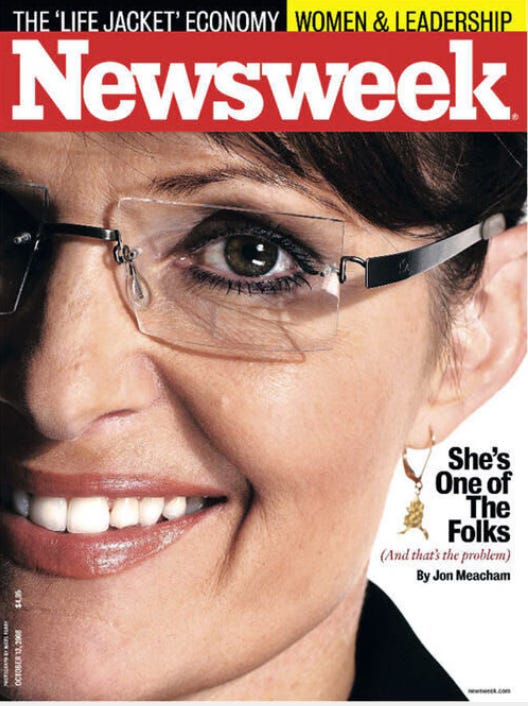
Explaining Newsweek’s cover choice, Julia Baird wrote in a 2016 opinion column for The New York Times, that this image (above) was in fact a cropped version from an earlier photograph that had been made for a previous Newsweek cover: “Take, for example, an incident during the run-up to the 2008 presidential election when I was a senior editor at Newsweek. We were given about 15 minutes to snap Senator John McCain and his running mate, whose identity was at that time a guarded secret: The photo of Mr. McCain and Ms. Palin ran on the cover of our Sept. 8 issue, devoted to the Republican convention.
“Two months later, we ran a cover story on Ms. Palin with the tag line ‘She’s One of the Folks.’ The editor in charge of covers, Bruce Ramsay, said he wanted a more intimate portrait, so we used a closely cropped version of the earlier image.
“A female staffer noticed that the crop revealed some untended lip and eyebrow hair, but Mr. Ramsay decided to go ahead with the image unaltered, for several reasons. The magazine had a policy of not retouching photos, and Mr. Ramsay wanted the strong eye contact in the image; in any case, the facial hair was barely noticeable.
“Once it hit the newsstands, though, conservative commentators fumed, accusing Newsweek of trying to damage Ms. Palin. One Republican media consultant called the cover ‘mortifying,’ ‘a clear slap in the face.’ The image ‘highlights every imperfection,] she said. ‘We’re talking unwanted facial hair, pores, wrinkles.’
“A media business analyst decried it as an insult. ‘Here’s your beauty queen,’ he wrote. Ms. Palin was ‘your ‘hottest governor from the coldest state.’ How do you like her now that you’ve seen her crows’ feet, her clumpy mascara, her bloodshot eyes, her faint mustache, her cakey makeup, her gaping pores etc?’
Baird continues: “In short, Newsweek was accused of sexism because we did not airbrush the photo. The truth was, we’d portrayed Ms. Palin just the way we did male candidates.
“‘What was most interesting about the episode is that Newsweek (and probably other media) typically shot men and women differently for news covers,’ says Mark Miller, who was Newsweek’s assistant managing editor in 2008. ‘So when the photographer and crew set up for the August shoot [of McCain and Palin together], the lighting was created in anticipation of a male candidate. It was, for lack of a better word, harsher than we would have used for a woman.
“In effect, we had typically ‘man lighting’ and ‘female lighting’ — and they weren’t the same. Also, because our editorial policy was not to alter news photos, we generally did not use close-up images of women on the cover because of the potential for an unflattering image.’”
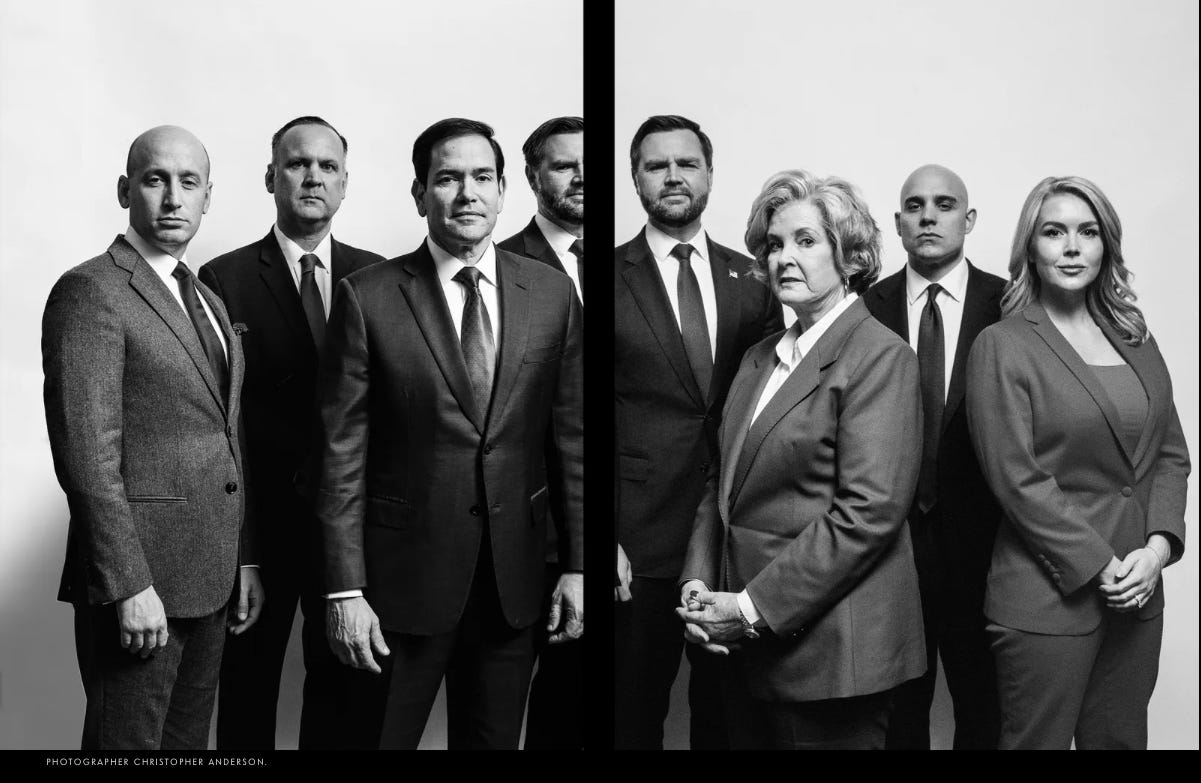
To Chris Anderson’s credit, his approach does not differentiate between men and women as apparently happened at Newsweek nearly two decades ago. Instead, Anderson demonstrates that photography can still help us to comprehend others, even those with great power, as complex and vulnerable people rather than automatically deferring to them and celebrating their status, such as in the portrait of the group (above) and the Secretary of State, Marco Rubio (below), for whom the weight of the world seems that it may be too much to handle.
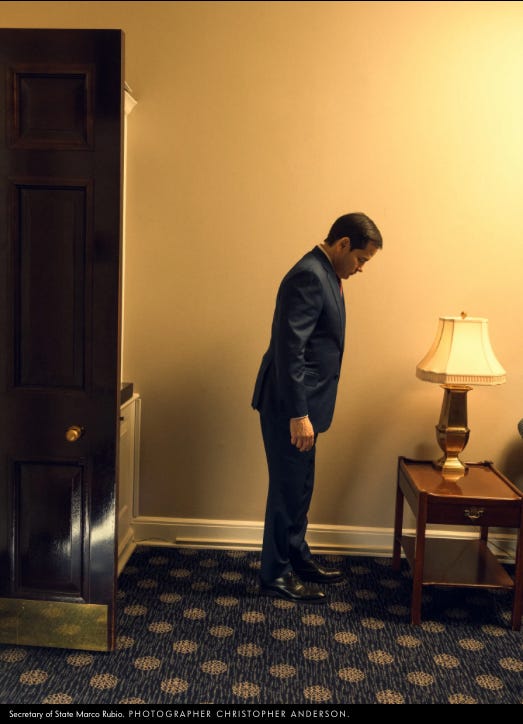
Others have made such interrogatory portraits before, including Richard Avedon’s compilation in his “Portraits of Power.” But now, as journalism is being disparaged and demeaned, it is critical to remind ourselves that it is not only the subject but the photographer who also has power, as an observer trying to understand and not as an acolyte focused on affirming the prestige of others.
This approach, which is the essence of portraiture, takes self-awareness, courage and persistence on the part of the photographer, supported in this case by the backing of a magazine that, unlike some other media outlets, is still able and willing to take a stand.
All photographs above, other than the Newsweek cover, are by Christopher Anderson/Vanity Fair.
“In photography," Gisèle Freund wrote in her autobiography, "it is the model that counts and the role of a good photographer is to be the sensitive instrument by means of which a personality is revealed.”
From all the tremendous press this story has received, it appears that I am alone in my estimation. I LOVE these images, but not for the same reasons everyone else seems to... I love them because they serve as a powerful reminder of the subversive potential and power of propaganda. And yet, it appears we have become blind to it which is frightening and perplexing.