
"A five-alarm fire"
Can visual journalism help to save democracy in the United States?

Margaret Sullivan, previously the public editor of The New York Times and media columnist for the Washington Post, publishes a Substack column entitled “American Crisis.” In today’s report, entitled “America has tragically changed, but journalism is still stuck in old ways,” she writes in the subtitle that “The swift slide into authoritarianism should have been a five-alarm fire for the media” but concludes that it has been mostly business as usual.
She references an article recently published in Foreign Affairs by three academics: “‘In 2025, the United States ceased to be a full democracy in the way that Canada, Germany or even Argentina are democracies.’ It is what they call a ‘competitive authoritarian’ system now, they write, following the path of countries like Hungary.
“‘In Trump’s second term, the United States has descended into … a system in which parties compete in elections but incumbents routinely abuse their power to punish critics and tilt the playing field against their opposition.’”
And, Sullivan writes: “Journalists (with a few exceptions) are mostly documenting what’s happening and applying the same old journalistic techniques and traditions to the vastly different situation. There are minor adjustments but very little sense of the five-alarm fire.
“Trump is covered, for the most part, like all those other presidents — the ones who, despite their flaws, were not busy dismantling our democracy. Trump is covered with deference; with headlines and stories that often take him at face value.
“When he insults and disparages the press, the members of the press corps simply take it — because they’re professionals who stick to business, which is too often the business of stenography.”
Her last statement reminds me of what Charles Baudelaire famously said about photography in its early days, in 1859, when he called it no more than a recording device to be used by “the secretary and clerk of whoever needs an absolute exactitude in his profession… But if it be allowed to encroach upon the domain of the impalpable and the imaginary, upon anything whose value depends solely upon the addition of something of a man’s soul, then it will be so much the worse for us!”
What is missing today is in fact the “soul” that Baudelaire warned against, a moral engagement with current issues coupled with resolve. And that applies as well to visual journalism, which urgently needs to explore the ramifications of the current crisis and the systems underlying it rather than, as is too often the case, peppering viewers with myriad images of government officials as they further distort the truths of what is actually going on.
Why can hundreds of photographers denounce the mistreatment of Nick Ut as the author of the famous photograph of nine-year-old Kim Phuc burning from napalm during the Vietnam War, an image that did much to both define that conflict and provoke questions as to its goals, but not also ask how all of us can be useful in combating this “five-alarm fire”? Why are the myriad photographic institutions — museums, schools, galleries, agencies, etc. — as well as many of the outlets publishing photographs, not asking the same question?
Furthermore, why are we not all joining together to see how this rapid transformation into fascism can be countered with visual evidence of the growing dystopia around us? Why are foundations or wealthy individuals not sponsoring a widespread documentation of these challenges to democracy and to the common good, building upon previous models such as, to name two highly celebrated ones, the Farm Security Administration and the Photo League?
There are, of course, many working in various ways to do just this, as well as numerous individual photographers. One such series by The Guardian is entitled “One day in Trump’s America,” described as “a weeklong series depicting the impact of the Trump administration on lives in America” (see below).

But shouldn’t we at this point try together, as a community of image makers and curators, designers and writers, editors and programmers, to strategize on both how to unify the constructive, exploratory work being done, including the masses of images and videos on social media, as well as on how to produce new projects, in order to underline and challenge the cruel deceit of current governmental policies?
Might we implement widespread outdoor and indoor exhibitions to show this work, including pop-up shows and billboards, or put screens in schools, museums, union halls, churches, galleries, etc., or build websites to aggregate a diversity of perspectives, or publish zines and distribute them widely, or coordinate a nuanced, empathic social media campaign?
Most of all, shouldn’t we be simultaneously asking how to reach all Americans, not just those from a specific political perspective or those already interested in the medium of photography? A major criticism of the Democratic Party in the last election is that it took the concerns of too many people for granted, not bothering to reach out to them where they were.
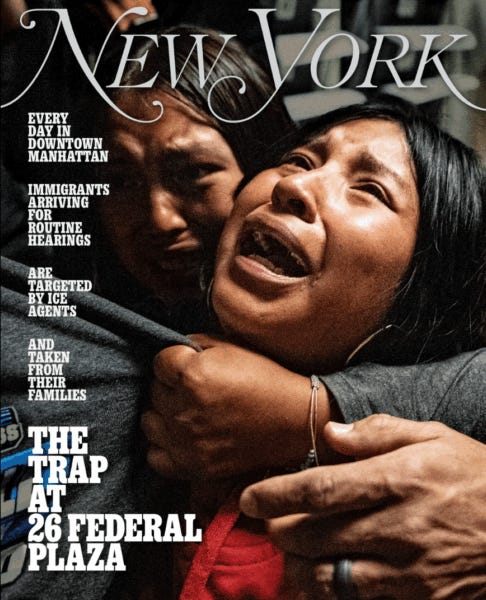
And, as has become clear in the most recent local electoral successes for Democrats, a large number of people’s focus now is upon very pragmatic issues — having enough to eat, medical support, a job, childcare. Certainly it would help to redirect the nation’s compass to have a visual, more visceral sense of those who are hurting the most. Arrests by ICE, as cruel and unwarranted as they are, make up just a small, if vicious, part of a much bigger if less spectacular picture that needs to be represented.
An OXFAM report on wealth in the United States, issued just last month, concluded that “While the wealth of the working- and middle-classes has barely grown in more than 30 years, the gains at the very top—disproportionately wealthy White men—have been astronomical. The share of national income going to the top 1% doubled between 1980 and 2022, while the share going to the bottom 50% decreased by one third. Today, the richest 1% own half the entire stock market (49.9%), while the bottom half of the U.S. owns just 1.1%. And as of 2024, over 40% of the U.S. population—including 48.9% of children—is considered poor or low income.”
How can 48.9% of the children in a wealthy country be “poor or low income”? Given current policies, it is a percentage that is likely to get much worse.
Obviously there is much to document. We must find a way to do it now, with impact, rather than as a grim retrospective sometime in the future.
Tomorrow, December 16, 11-11:30 am ET I am doing an info session about my upcoming Masterclass courses with StrudelmediaLive, Innovative Strategies for Exploring the Human Condition (Wednesdays, Feb 11–Mar 11, 2026) and Advancing the Personal Project for Social and Individual Change (Wednesdays, Mar 25–Apr 29, 2026). These courses are for photographers, curators and others interested in using alternative visual strategies in effective, impactful ways. Register here.
The third and final lecture, Impactful Imagery in the Age of AI, from my lecture series Toward Authentic Visual Narratives in an Age of Menace and Confusion, is this Thursday, December 18, 1-3 pm ET, where we take a deeper look at many of the issues I’ve discussed on Substack. Sign up for it here. Proceeds go to the Committee to Protect Journalists.
Please consider, if at all possible, becoming a paid subscriber.
It is imperative that many of us start working together to move things to a more rational place. More on this soon. Thanks for your comment. It’s really helpful.
Thanks Fred. It is so valuable to have your voice here. I have also been attending the SML lectures. Great resource. Much to discuss. I would love to connect on ways to equip imagemakers (and supporters) for what is coming and more urgently what is being missed in the shock and awe age of Trump. Alternative dissemination is vital. I heard the words “three more years” on the news today with a thump in my entire being, following that - “unregulated AI” as policy and then a story on Trump and Silicon Valley nuclear goals for 2026. They seemed so excited as if the entire world chose any of this when of course we know a handful of people are designing the future of how the rest of us experience life and the future of life on the planet. There must be massive shifts now.